SoundsPedal Synth
Tokyo Drift synth
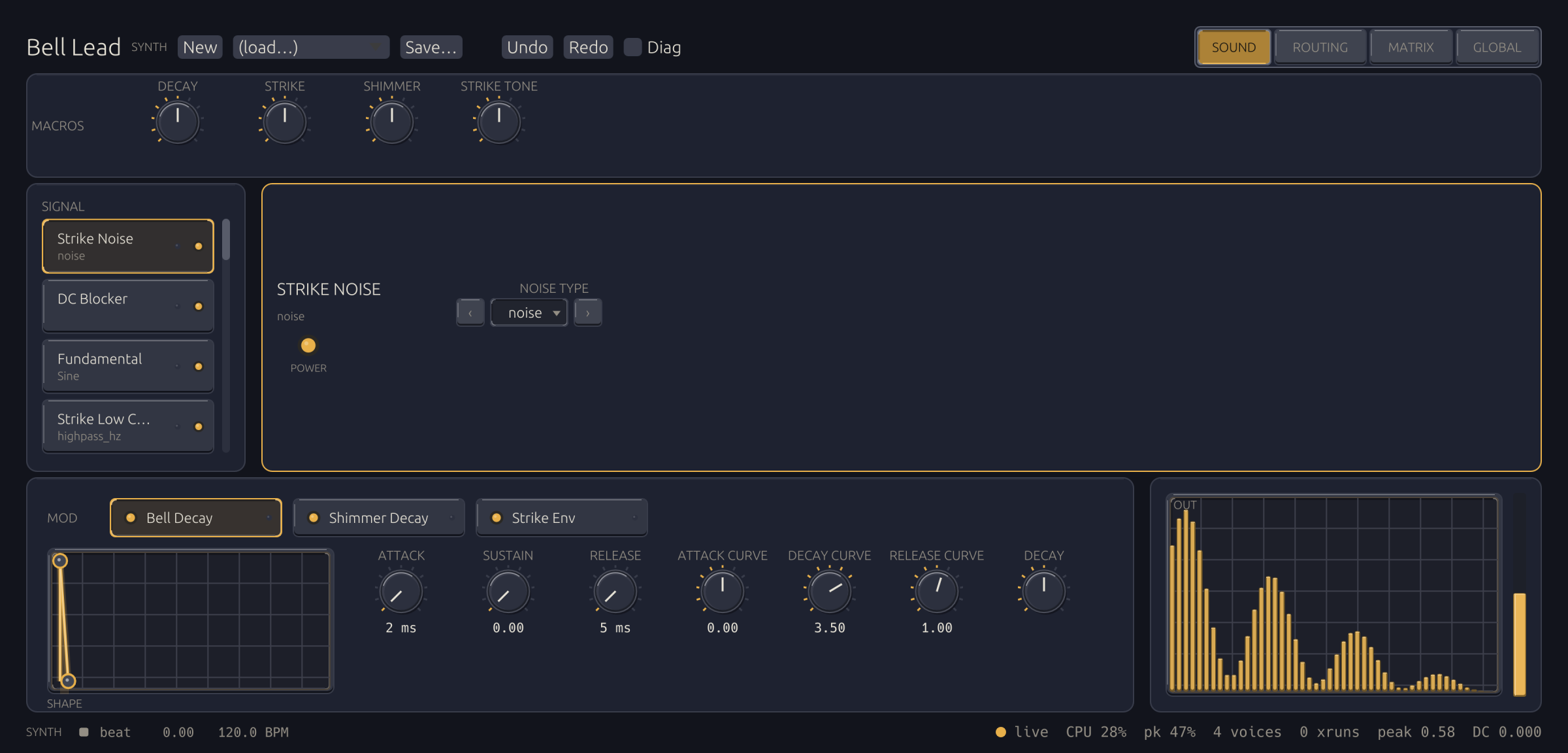
A bright struck bell: a metallic ping on every note that rings for about a second and stops when you let go. It is the Tokyo Drift bell riff sound. The free preset builds it from sine waves alone, tuned between the harmonics the way a metal bar rings, plus a short burst of noise for the strike. No samples.
Build it with an agent
Paste this into your MCP client with Pedal open. The animation below is the same chain writing into the plugin.
Agent prompt
use pedal to make the Tokyo Drift synth bell with additive synthesis: a sine fundamental with a 2 ms attack, 1 s decay, sustain 0 and 5 ms release; sines at 3.664×, 3.584× and 4.115× the note at −13, −17 and −25 dB on the same envelope; a shimmer group of sines at 7.18×, 7.9×, 1.81×, 7.554×, 8.402×, 7.347× and 8.07× from −14.5 to −28 dB on a 0.8 s decay; a noise strike through a 200 Hz high-pass and an 11000 Hz low-pass with a 60 ms decay at −2 dB; and a 2500 Hz air band at −30 dBpedal-mcp · inharmonic_bell.psy
Hear it
How to make the Tokyo Drift synth bell
- Start with one sine
A sine that rings down on its own and stops when the key lifts. Short notes give short rings.
- Add the metal
Add three sines tuned between the harmonics, each a little quieter. That off-harmonic tuning is what makes it ring like metal.
- Add the shimmer
Add a cluster of higher sines on their own, shorter envelope. The top sparkles first and fades first.
- Hit it with noise
A very short burst of filtered noise on every note is the mallet. A faint band of noise underneath adds air.
- Download the preset
Load it in Pedal Synth and play short notes. Four knobs control the ring time, the strike, the shimmer and the strike tone.
Pedal chain
Plain-language stages for the free preset. Exact numbers match the downloadable patch.
- oscillator → adsrFundamental
Sine. Attack 2 ms, decay 1 s, sustain 0, release 5 ms.
The body of the bell. It rings down on its own, and the short release stops it when the key lifts.
- scale → oscillator → gain_dbBody partials
Sines at 3.664×, 3.584× and 4.115× the note, at −13, −17 and −25 dB.
None of these land on a harmonic. That is what makes it ring like metal instead of a saw or a pulse.
- scale → oscillator → gain_dbShimmer partials
Seven sines from 1.81× to 8.402× the note, −14.5 to −28 dB, on a 0.8 s decay. Shimmer knob −40 to −6 dB.
The high cluster fades a little faster than the body, so the attack sparkles and the tail stays round.
- noise → highpass_hz → lowpass_hz → adsr → gain_dbStrike
Noise, high-pass 200 Hz, low-pass 11000 Hz, attack 0.5 ms, decay 60 ms, level −2 dB. Strike knob −30 to 6 dB. Strike Tone knob 2000 to 16000 Hz.
A short burst of filtered noise is the mallet hitting the bar.
- bandpass_hz → gain_dbAir and decay
Air band 2500 Hz, Q 0.5, at −30 dB. Decay knob 0.3 to 3 s.
A quiet band of noise fills the space between partials. The Decay knob sets how long the whole bell rings.
Preset
FAQ
Is this the record's sound?
No. inharmonic_bell.psy is an original Pedal Synth patch built only from sine waves and noise, with no samples. The demo plays an original phrase, not the song's riff.
Why scale nodes instead of harmonics?
A harmonic oscillator puts partials at whole-number multiples of the note. A struck bar rings between them. A scale node multiplies the note pitch by any ratio, so each sine sits exactly where the bell rings.
Is Pedal affiliated with the artist or label?
Pedal is not affiliated with or endorsed by the artist or label.
Which plugin loads the preset?
Pedal Synth. The free download is inharmonic_bell.psy.